
By Candela Iglesias Chiesa, MPH, PhD
Before turning to global and public health as a career path, I was a biomedical scientist. My long days in the lab were split between “the bench” (doing experiments) and the computer, where I read peer-reviewed articles on my subject matter.
Ever since, whenever a health matter pops up for myself or a loved one, my first impulse is to go to PubMed (a repository of peer-reviewed articles) and read up on the subject.
Over the years, I’ve come to realise what a privilege this is. I can have informed discussions with doctors. I can ask deep questions. I can advocate for the treatment or care that is considered the gold standard.
What Is Health Literacy
Health literacy, defined by WHO as “being able to access, understand, appraise and use information and services in ways that promote and maintain good health and well-being”, is a key component of access to health that many times, unfortunately, gets overlooked.
It sits at the intersection of three concepts that are closely related but distinct:
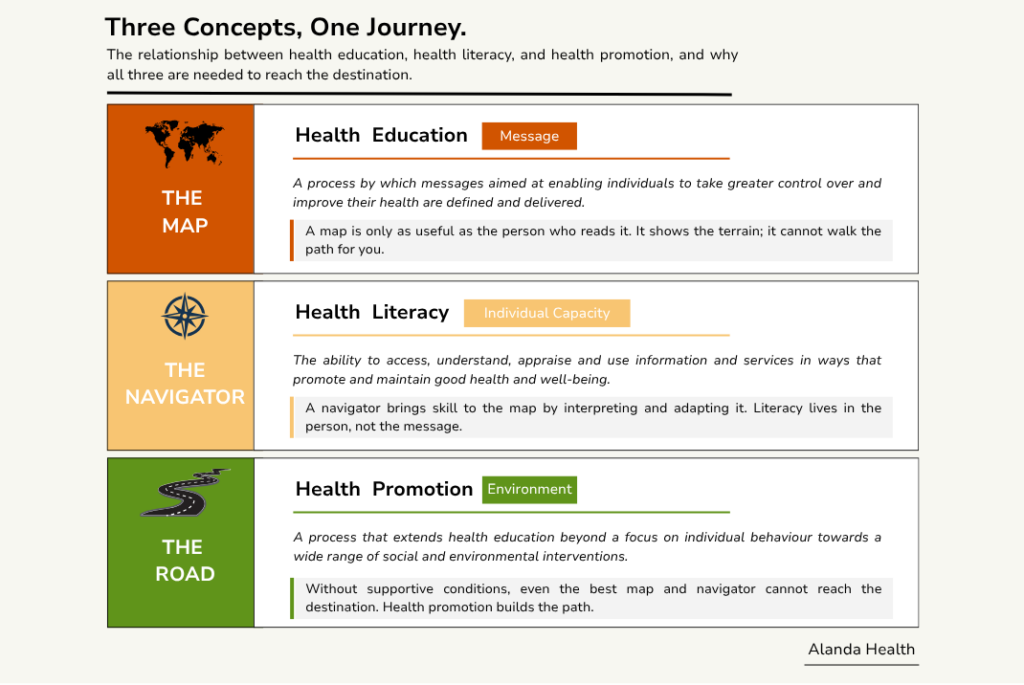
- Health education delivers the message — it’s the map.
- Health literacy is the individual’s capacity to read and use that map.
- Health promotion shapes the environment — it builds the road.
Brilliant initiatives ensure health literacy and its cousins, health education and health promotion are included in interventions, and the results are inspiring.
-
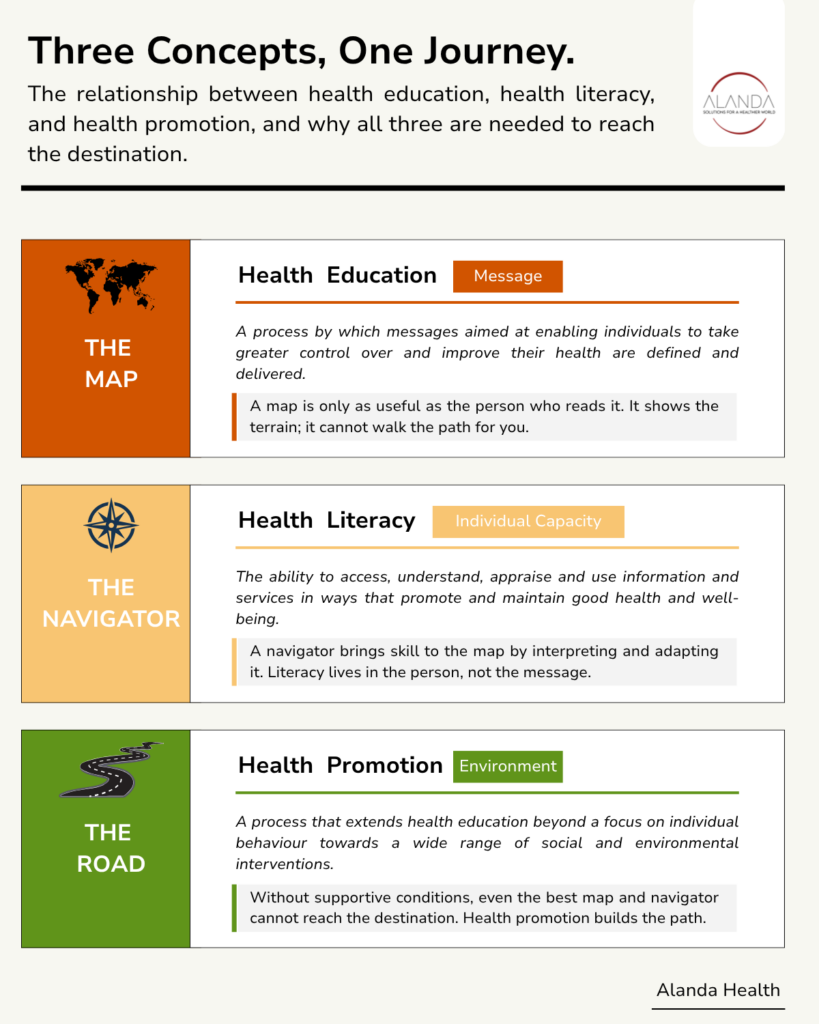
Figure 1. The relationship between health education, health literacy, and health promotion as three interconnected components of the journey toward better health outcomes.
What Good Looks Like: Three Examples from the Field
At Alanda, we evaluate health and development projects across the world. Last year, we came across several initiatives that got this balance right and the results were inspiring.
Ukraine:
In mobile health units serving hard-to-reach populations of older residents, doctors and nurses did more than treat patients. They informed people of their health rights under national law, including free services and medicines, and helped them register or re-register in the national health system. Knowing a right exists is meaningless if you can’t access it. This team made sure people could.
South Sudan
Red Cross volunteers in South Sudan helped manage cholera cases in the community. They informed people about the risk of dehydration and using oral rehydration salts when someone got sick. They also reinforced the importance of hand washing, using safe drinking water, etc. And most importantly, they provided access to safe drinking water and to oral rehydration salts. Knowledge and access, delivered together.
Niger and Sierra Leone:
Income-generating activities and savings and loans initiatives for women in Niger and Sierra Leone were linked to maternal health promotion, ensuring a portion of funds were reserved for emergency obstetrics and maternal health needs. By meeting women inside economic initiatives they were already engaged in, health promotion reached people it might otherwise never have.
What I Learned About These Initiatives
Looking across these examples, three principles stand out.
- Pairing health education with action. Sharing knowledge is not enough. What really turns the tide is ensuring the actions to facilitate access: registering people in the national health system, giving out oral rehydration salts, providing a way to access healthcare.
- Reaching people where they are. Mobile health units, community health workers and volunteers all go towards the population. This takes care of other barriers in access to health such as geography, distance, transportation and childcare costs.
- Integrating interventions. Sometimes we think too narrowly inside the health sector. I’m seeing more and more integrated interventions in many projects we evaluate and the benefits are clear. Pairing nutrition advice with community gardens helps communities take up that advice. Building or improving sources of clean water helps communities act on hygiene promotion messages. Livelihood initiatives that bring women together create momentum for maternal health action.
The Bottom Line
Health literacy is not a nice-to-have. It is a prerequisite for equitable healthcare. But it cannot exist in isolation. Without education, people lack the message. Without promotion, they lack the environment to act on it.
The good news is that when all three work together, as these examples show, the impact is real, measurable, and deeply human.
At Alanda Health, we evaluate programmes that put these principles into practice. If you’d like to learn more about our work, book a call with me and let’s chat!
Thanks for reading and for making a difference in this world. If you found this post valuable, here is how you can take the next step with us: Sign up for our newsletter.
If you like our articles, make sure you get them directly in your inbox. We send one newsletter per month.
If you liked this post, you will also like:
- The Power of Role-Play in Training
- Alanda’s 3 E’s Framework: Evidence-based, Evidence-generating and Evidence sharing
- Mastering Global and Public Health Presentation Skills: Your Passport to Impactful Communication
- After Action Reviews (AARs): a tool to openly discuss successes and failures of your health intervention