
By Candela Iglesias Chiesa
One thing you probably don’t know about me is that I’m a certified HIV counsellor. (I have not practiced for over 10 years, though!)
The certification course was excellent. The trainers knew they were working with professionals who knew a LOT about HIV and AIDS, so they kept the theory to a minimum and ramped up the practice.
How do you practice talking to a person who is scared of getting an HIV test? Or telling someone very angry that their HIV test came out positive?
Through role play.
We spent hours alternating between the counsellor and the person seeking HIV testing roles. At first, our colleagues role-playing the person seeking out testing would act as an “easy” case, and then progressively portray more difficult cases (angry, aggressive, crying, etc).
It was tough, it was uncomfortable, and we felt extremely self-conscious.
But we left that training feeling confident we could handle even the most difficult situations.
If you have never participated in a training using role-play, it goes like this: One or several people (the “actors”) act out roles from a real life setting (e.g. a patient, a community member, a politician, etc), another person (the “trainee” or the person in the “hot seat”) acts out the role of the health professional (a nurse, a community health worker, etc). The rest of the group observes and later provides feedback.
The “actors” usually have instructions on how to act out their role, and the level of difficulty to infuse into the role play. The trainee also has instructions, usually a goal or a list of outcomes they need to accomplish, or skills they are asked to showcase (e.g., listening, advocating, etc.)
Role-playing as a training methodology has a lot of advantages:
- It puts us as close to a real-life scenario as possible, while still in a safe learning environment.
- Research shows that role play has a positive impact on developing practical skills and improving performance.
- It can be particularly useful in settings where communication and negotiation, or even teamwork, are needed.
There is another advantage that sometimes gets glossed over, though:
You might also need to role-play the “actor” side, whether that’s the patient receiving a cancer diagnosis, the pregnant woman receiving a community health worker during a household visit, or the teenager requesting sexual and reproductive health counselling for the first time.
This forces us as health personnel to put ourselves in the shoes of the people we serve, and to see things from their perspective:
- “Why is the nurse so insistent I start treatment, can’t they see I need time to process this diagnosis?”
- “Can’t she see I’m busy with the kids? I can’t answer her 20 questions right now!”.
- “All I want is a condom. Why do I need to sit through this lecture?”
I have seen firsthand how this creates empathy and understanding. I’ve seen stoic professionals get teary-eyed after a role play, as they internalize what it means to be on the receiving side and reflect on their previous performance.
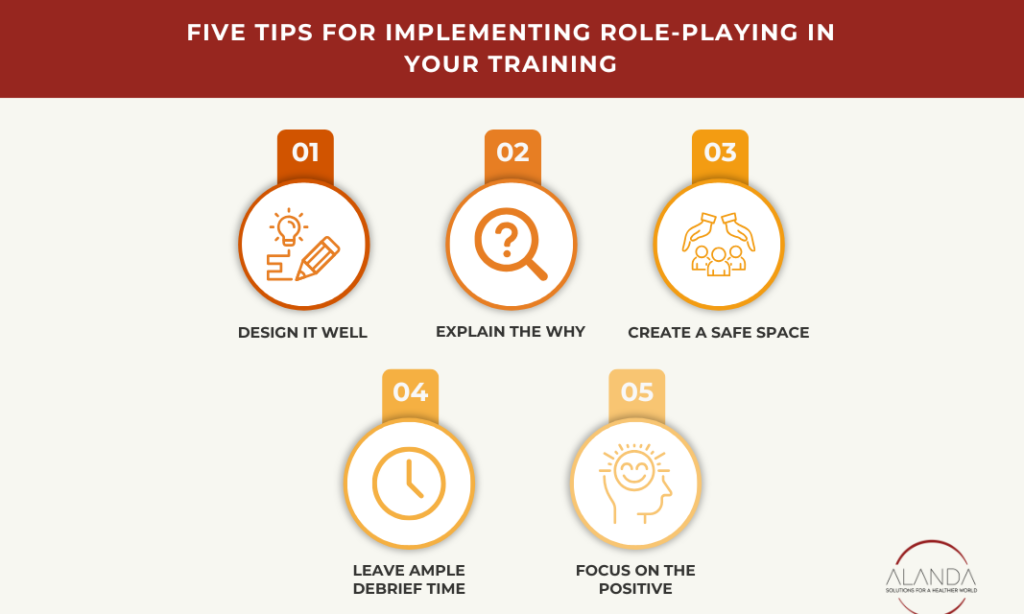
So if you want to start using role-play in your training, here are five tips to get started:
- Design it well:
- What are the skills you want participants to learn? Narrow it down to 3–4 so you can focus on observing those.
- What is the specific situation or scenario you want to put participants in? Base them on real-life examples as much as possible.
- Develop specific instructions. Describe the actors’ roles well and specify how “difficult” you want them to make the interaction. Clarify the role of the trainee in the hot seat. Fuzzy descriptions lead to fuzzy results.
- Explain the why: I’ve heard people complain about role plays before experiencing them in training. They mumble that they are not actors, and this is a fake setting, etc. It helps to explain why this methodology was chosen and how effective it is.
- Create a safe space: Role-plays are hard and make us feel vulnerable and observed. Attempt them only if you can truly create a safe learning environment. This means the trainees trust the facilitators and each other and feel comfortable enough to be put on the spot. Everyone needs to agree on guidelines on confidentiality, how to give feedback, permission to skip the exercise (remember some people might have previous personal experiences that make the exercise particularly difficult), etc.
- Leave ample debrief time: Make sure everyone participating, starting from the person in the hot seat, gets a chance to share how they felt, what they think they did well, and how they could improve. If time allows, observers not participating in the role play can also give feedback. As people get more comfortable with the methodology, you’ll need less debrief time.
- Focus on the positive. It’s hard enough being on the hot seat. If you’re the facilitator, don’t give the person a long list of things to improve. Focus first on what they did well and point it out to everyone participating. Add 1-2 areas of opportunity they can focus on for the next role play.
—
If you are experiencing any of the issues below, we can help:
- Your training program is not delivering the results you expected.
- You don’t have a way to measure the results of a training beyond a pre-post training quiz.
- You rely on several experts to present the training, but they are not creating a participant-centered experience.
- Your training program relies on unidirectional, passive approaches that don’t truly engage the participants (hint: no role plays!)
- You would like to use adult learning science to improve your training.
Book a call with us and let’s chat. You can share the issues you and your team are experiencing and we can share the potential solutions that might work best in your case.