
By: Candela Iglesias Chiesa
In 2016, I went to Angola as part of a team to support the Angola Red Cross during a yellow fever outbreak. We worked with them on health awareness and sensitizing the communities to yellow fever and the importance of vaccination.
A vaccination campaign against yellow fever had just taken place in the localities where we were working. The government and the WHO knew that not everybody had gotten the vaccine and were trying to get data on who still needed to get vaccinated. This did not directly concern our work, so it was not at the top of my mind.
One afternoon, I was chatting with a few Angolan Red Cross volunteers. They told me they had been carrying out household visits. I asked what the conversations with family members had looked like.
They told me what they had asked about, such as the number of family members and vaccination status for yellow fever.
Wait, WHAT?… I almost choked on my coffee.
“You collected data on how many family members were vaccinated?” I asked (maybe a bit loudly out of excitement)
“Yes”, they answered tentatively.
“Where is that data? Can I see it?”
They seemed a bit taken aback by my excitement. So I explained that people were looking for information on how many in the community were vaccinated, and their data might hold the answer to that question!
They left the room and came back with piles of dark green binders containing neatly arranged sheets of paper where they had collected the household visit data.
They laid them down, uncertainly, in front of me. Like they thought I would criticize it.
My eyes grew bigger and bigger as I skimmed through the sheets.
This was a gold mine!
We could not only answer WHO’s and the government’s questions on who still needed a vaccine in the community but there was other very valuable information including on vaccine hesitancy and reasons for it!
I couldn’t believe it. All this time, they had been sitting on a treasure trove of information, that everyone else was desperately looking for.
We quickly got the green light to collate and analyze the data. The volunteer team was all in, having understood the value of the data they had collected, and feeling very proud of their efforts (with good reason!). In no time, we had inputted all the paper data into a database and shared analyses with partners.
I have reflected on this incident many times. I have seen this disconnect between the people collecting the data and the people needing the data in several scenarios since then.
Whenever I work with an organization or a project, I sniff around for data. The best way to do it is by asking people in the trenches curious questions about their work, ensuring they don’t feel like you’re intruding or evaluating them.
I also ask for any type of data they are collecting.
- Even if they think it might not be valuable…
- Even if they think it is incomplete or imperfect…
- Even if it’s on paper, on an old hard drive, a phone (floppy disks, anyone?!)
This works. I’ve found so many treasures.
I’ve helped analyze data that otherwise would have been left forgotten in a drawer or a computer.
The data has not been perfect, it has had holes and inconsistencies.
Here’s a little secret though: All data has issues. Even the most pristine data in the best clinical trial has issues.
Yours will have to. That’s ok.
So here’s a fun little challenge:
- List at least 3 datasets you or your organization collects or holds that are not being used or analyzed, either because you don’t have the time or the skills, you don’t think it’s very valuable, or because of concern about how the data was collected (e.g. it’s on paper, it has holes or inconsistencies, etc).
- Spend 5 minutes brainstorming how you or your organization could use this data, or who could find it valuable.
If you care to share with us, send us an email via projects@alandahealth.com and tell us about your list. We’ll select three emails and write back with our suggestions on how to analyze and use the data.
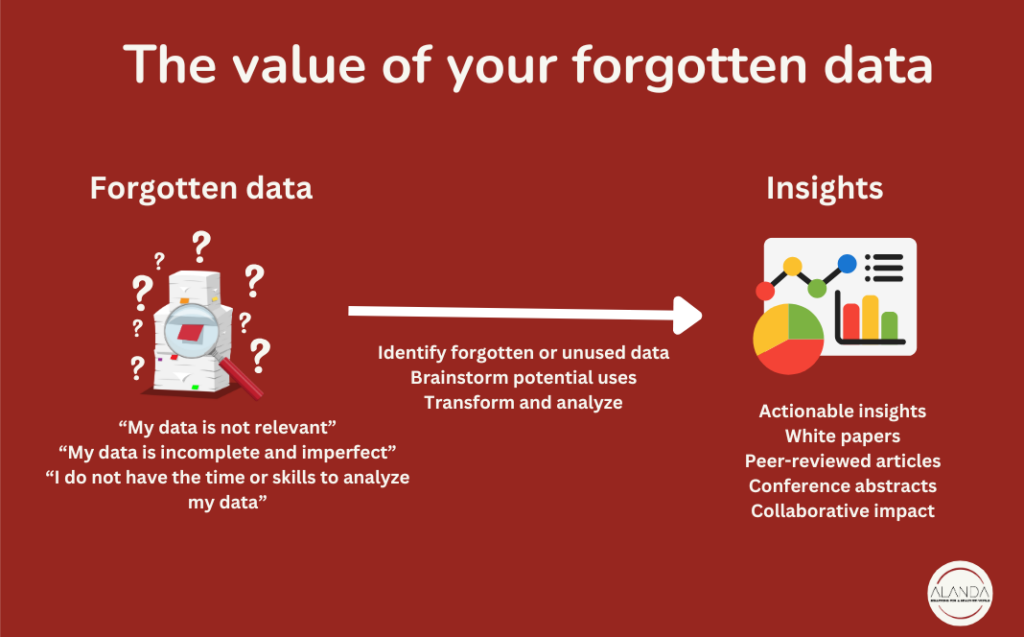
You never know, there might be a white paper or a peer-reviewed article in the future of your forgotten data!
p.s If you’re experiencing any of the issues below, we at Alanda can help.
- Your monitoring and evaluation system is in place but does not work well in practice.
- There are holes in the data you are collecting.
- People on the ground are not filling out the data collection tools completely or correctly.
- Your donors require quantitative results but your current systems collect mostly narrative data.
- You’re still mostly using a spreadsheet to collect and analyze data.
- You have good indicators but people measure them in whatever way they want.
Book a call with me and let’s chat. You can share the issues you and your team are experiencing and I can share the potential solutions that might work best in your case.