
By: Candela Iglesias Chiesa
Years ago, while working at an HIV clinic, I started asking questions about the cohort of people we served (mostly people living with HIV and their families).
I wanted to know how well our programs were working for them (including clinical care and psychosocial support interventions, such as workshops on nutrition, understanding HIV, and managing a chronic condition) and I needed data. I sent what seemed to be simple requests for data, but they went unanswered.
When I poked around for data, my colleagues were reticent. I quickly realized that I wouldn’t get far if they got the smallest impression that I was there to evaluate their work.
So I turned on my curiosity. Instead of asking about data, I asked them about their work: what they did first, what they did next, when did they talk to our beneficiaries and what they asked them about, where they collected the data gathered, and about the friction or challenges in the process.
For example, one social worker told me she saw patients after their first medical appointment. She collected data on age, education level, income level, household characteristics, etc. She explained that some of this data was already available in the portal where patients registered for medical appointments, but she had to inquire again because she did not always have access to this portal, and she felt bad about wasting the patient’s time by asking for data we already had.
Asking people about their work changed the tide. People went from reticent, to very happy to talk with me. It felt more natural to ask about the type of data they collected as they described their step-by-step work. I learned what data was being collected and when, and I about the challenges and inefficiencies in the data collection process (and there were so many!).
Some people were doing almost heroic work, typing into a computer data that had been collected by another system (or on paper) day in and day out. It was mindlessly boring work born out of an inefficient process. And no one had explained to them the importance of the data they were inputting.
Others, when asked by the hospital bureaucracy or myself to provide certain numbers, had to cross-check and compare data from at least 3 different databases. Manually, of course. I realized the effort that went into answering one of my “simple requests” for data.
I became much more aware and respectful of the work of the people collecting or inputting data and realized that they were the ones who clearly understood all the inefficiencies in the system, but no one ever asked them for their input on how to improve it.
Many years later, this lesson still serves me well.
When a partner organization wants us to support them in developing or strengthening their monitoring and evaluation, we take great care to:
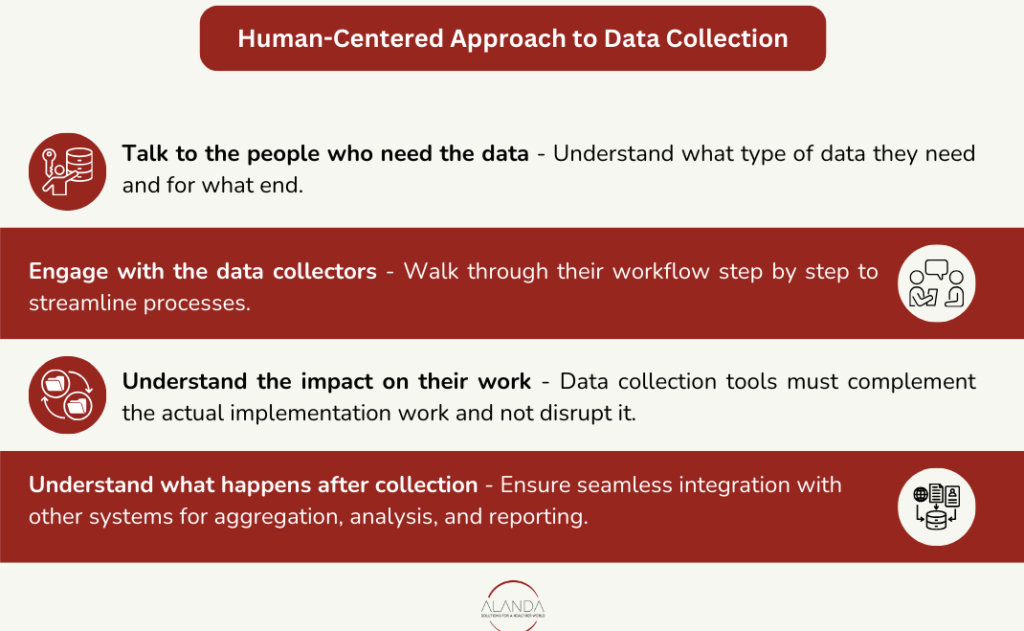
- Talk to the people who need the data, to understand what type of data they need and for what end (and also what other data they might be collecting that will have no good use in the end).
- Talk to the people who collect the data, understand their work step by step, and have clarity on when and how they collect the data.
- Understand how this data collection impacts their other work, their implementation work. For example, a community health worker might collect data on a cell phone while conducting a household visit, in which case the connection with the family is the key aspect of the visit, and the data collection should support – and not interfere with – this connection.
- Understand what happens to the data when it’s collected, and how the data collection system integrates into other systems used for data aggregation, analysis, or reporting.
Then we use the information to make the process as easy and frictionless as possible for all involved. In the household visit example, this includes the family member who is answering the questions, the community health worker who is conducting the household visit and collecting the data, and the person collating and analyzing the data at the local, country and/or global level.
We also focus on training and refreshers and highlighting to the people doing the data collection the importance of the work they do and how to do it more effectively.
Focusing on the human side of the data collection is key to ensuring a monitoring and evaluation system that works, where you won’t find lots of missing data, and which will allow you to showcase the results of your project.
What lessons have you learned on the importance of the human side of data collection? Share in the comment section below!
p.s. If you’re experiencing any of the issues below, we might be able to help.
- Your monitoring and evaluation system is in place but does not work well in practice.
- There are holes in the data you are collecting.
- People on the ground are not filling out the data collection tools completely or correctly.
- Your donors require quantitative results but your current systems collect mostly narrative data.
- You’re still mostly using a spreadsheet to collect and analyze data.
- You have good indicators but people measure them in whatever way they want.
Book a call with us and let’s chat. You can share the issues you and your team are experiencing and we can share the potential solutions that might work best in your case.